The AI Rush in Travel and Tourism
I’m certainly not the first person to write about it, and won’t be the last. The term and content that’s been filling your social feeds, showing up at every conference, and in daily conversations: Artificial Intelligence, or AI.
I hear others talking about it constantly, and if you are a brand or creative professional, you likely have questions. What tools are best? How should we use them? Are we moving fast enough?
The truth is, nobody has all the answers. But brands and agencies in our industry are moving quickly to adopt it, for better or for worse.
The pressure is real. Travelers expect brands to be available 24/7, responsive across channels, and personalized at every touchpoint, while still feeling genuine and distinct. AI promises speed, efficiency, and constant availability. For many brands, it feels less like a choice and more like a requirement just to keep up.
But speed alone doesn’t build brands. And efficiency, without direction, can quietly erode what makes a place special.
The challenge we are facing
AI can improve responsiveness and efficiency. But when it’s used without guidance, it can dilute your authentic voice and reduce a brand to something generic and interchangeable. The temptation to just let AI handle it is real. I feel it too.
The challenge isn’t whether to use AI. It’s defining how it’s used, what it’s allowed to do, and where its authority stops.

What’s the industry getting wrong?
Much of the conversation positions AI as a speedy replacement for strategy and creativity, rather than a tool to be guided by experienced hands. This creates a false sense that technology can define voice, that automation can replace judgment, and that faster is better.
In tourism marketing, that assumption is risky. You’ve seen the AI videos in your feed. I can hear that AI voice in my sleep. You know the one.
When AI operates without experienced direction, travel brands become interchangeable. Responses may be timely, but they lose nuance. Recommendations may feel personalized, but lack context. Over time, brand voice softens, storytelling weakens, and you begin to sound like everyone else.
You gain efficiency. But you run the risk of losing what makes people care – the Soul of your brand.
Where AI really helps
Does Paradise use AI? Of course we do. I personally love it. Our Brand & Creative team uses it every day, but we’re deliberate about how we use it.
It’s great at repetitive work, answering the same question for the hundredth time without getting tired or sloppy. If someone asks, “What’s the best hiking trail with a sunset view?” at 2 am, AI can respond while maintaining the voice we’ve trained it on.
It’s also useful for finding patterns we might miss. Looking across months of visitor data, AI can surface connections like people visiting the car museum also searching for kayaking. That’s actionable. A human still decides what to do with it, but now we know.
And for itinerary building, AI can do the heavy lifting if priorities are already defined. Those decisions come from people who are experts in that particular place or space. AI just assembles the pieces.
The pattern is simple. AI works when it’s executing something we’ve already defined.
Where people make the difference
Our expertise defines what matters. We establish the brand voice, the ownable storytelling, and decide which unique experiences should be elevated. AI is guided and constrained by our teams’ years of tourism brand experience.
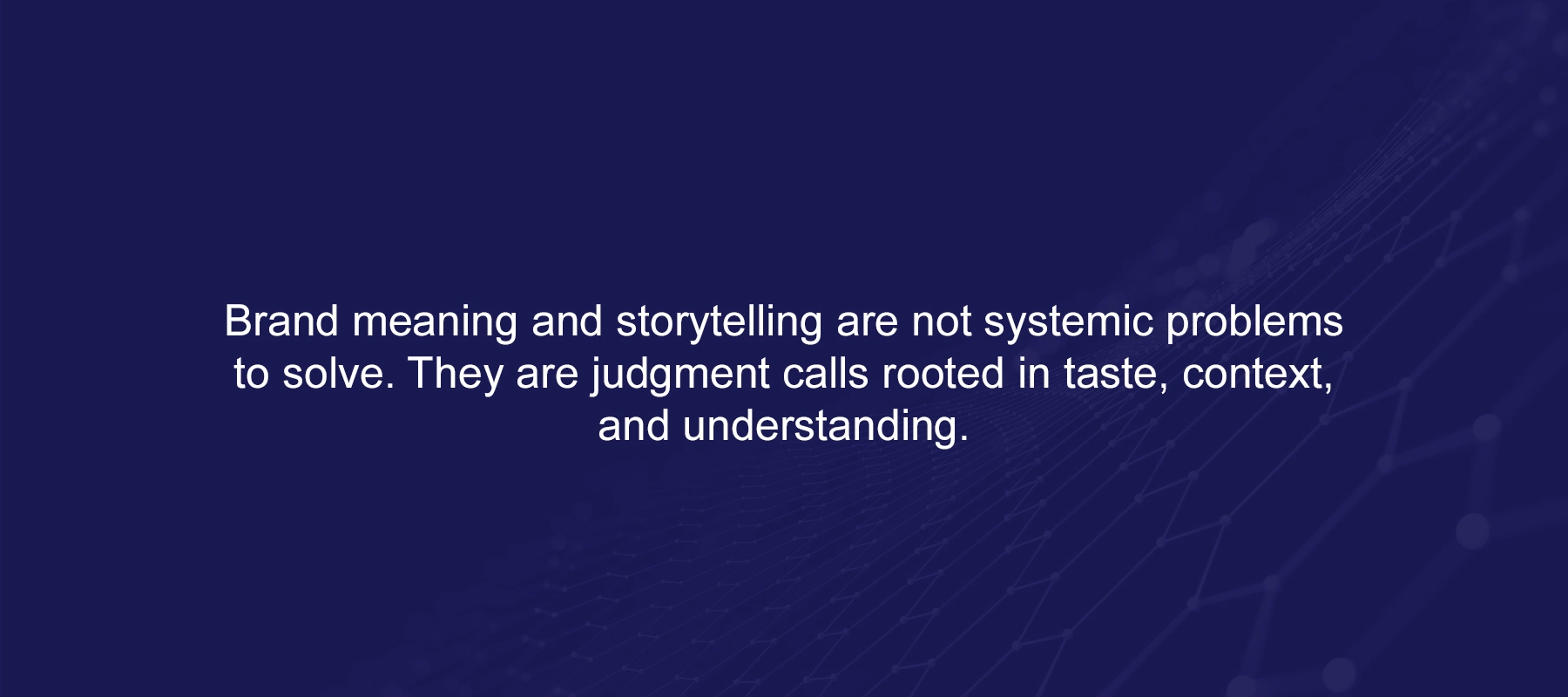
Brand meaning and storytelling are not systemic problems to solve. They are judgment calls rooted in taste, context, and understanding.
Our intersection of brand and AI
We draw a firm line around authorship. AI can automate conversations, uncover insights, and support planning, but it operates within a human-defined brand positioning and strategy.
We decide. AI executes. As AI improves, where that line sits will matter more than the line itself. Knowing what great is and why it matters is what keeps a brand’s identity authentic and intact.
Strategy, storytelling, and brand leadership come from our people. This is where judgment, taste, context, and long-term thinking matter most.
That also means there are clear boundaries. We don’t use AI to create original ideas, define brand identity, or replace human storytelling. Destinations, resorts, and attractions evoke emotion and meaning. These don’t hold up when automated.
This is where our value lives. It’s what our clients hire us for.
What this means for you
Tourism professionals shouldn’t just ask what AI can do, but who is guiding it.
Technology should support clarity and reinforce what makes each brand different, not quietly erase it in the pursuit of more.
The decisions you make about AI today will shape what your brand sounds like, and feels like, for years to come.
A final thought
Travel is not a product. Experiences are lived, and they carry real human, cultural, emotional, and economic impact. Automation should not define the tourism brand strategy or creative voice.
The places and experiences that stand out will be the ones that use AI without giving up control. It will be part of every strategic marketing plan. The difference isn’t adoption, it’s ownership.
Everyone’s using AI. The question is, who is creating the story your AI is telling?